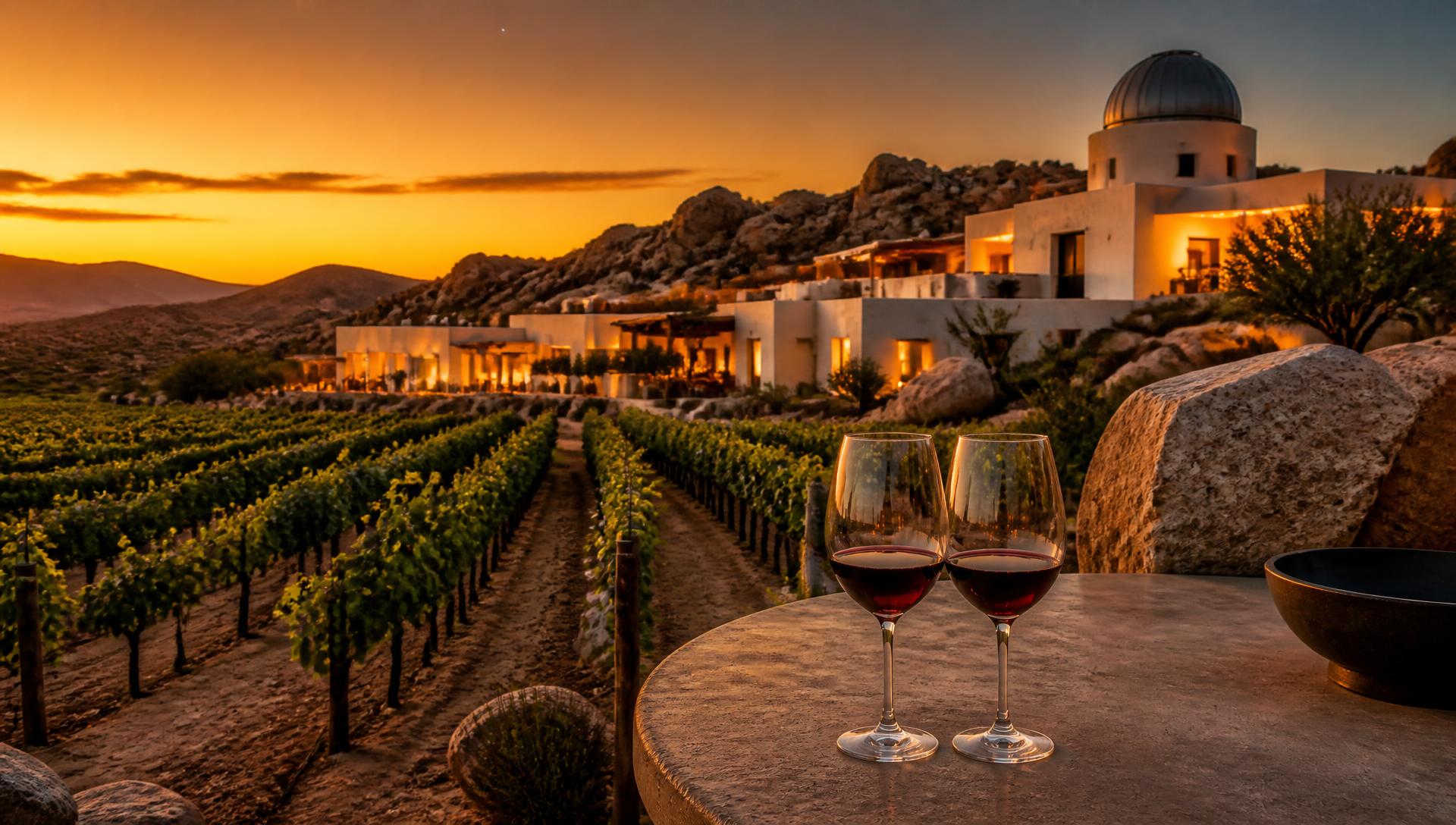
El Cielo, Valle de Guadalupe
Mexico's star-named winery, and the Baja table it was built for.
Drive inland from Ensenada and the landscape changes fast. The Pacific drops away, granite boulders push up out of dry hillsides, and then, suddenly, vines. This is Valle de Guadalupe, and El Cielo is one of the reasons people now fly into Tijuana specifically to drink.
The name means the sky. Everything at the estate follows that idea, right down to the wines, which are named for stars and constellations rather than blocks and vintages. It is a charming conceit, but it also happens to sit on top of genuinely serious winemaking.
Why Valle de Guadalupe Tastes Different
The valley is technically a desert that gets rescued every night. Cool Pacific air and fog roll in through the gaps in the coastal hills after dark, dropping temperatures sharply after days that can pass 35°C. Grapes ripen quickly in that heat but hold their acidity through the cold nights, which is why Baja reds can be full-bodied without tasting flabby.
The soils are arid, stony and clay-heavy, and the groundwater carries salinity. You taste it. Valle de Guadalupe wines very often have a faint saline, savoury edge on the finish — an olive-brine, sea-air quality that makes them unusually good with lime, chile and grilled seafood. That is not a marketing line; it is the single most useful thing to know when you pair them.
The Estate
El Cielo farms roughly 95 hectares across three sites — Valle de Guadalupe itself, San Jacinto and Ojos Negros — with something in the order of 85,000 vines and around fifteen grape varieties planted. That spread matters. San Jacinto and Ojos Negros sit at different elevations and pick at different times, which gives the winemaking team components with different acid profiles to blend from in a hot climate.
The property is also a resort: villas, restaurants, a spa and an events programme built around stargazing. It is one of the few places in the valley where you can taste through a full range, eat a proper Baja Med dinner and not have to drive anywhere afterwards.
The Wine Lines, Entry to Premium
Six lines, all named for the sky, arranged roughly in ascending order of ambition:
- Joven. Young, fruit-forward, made to be drunk cold on a terrace. This is the house-pour tier.
- Astros. Varietal wines, cleanly made, the everyday range that shows what each grape does in the valley.
- Astrónomos. A step up in concentration and oak, and where the reds start to gain structure.
- Constelaciones. Blends — the line where the winemaking decisions get more interesting.
- G&G by Gina Sommelier. A collaboration range, built around a sommelier's palate rather than a cellarmaster's.
- Estrellas. The premium tier: Procyon, Zeus, Polaris and Sirius. These are the age-worthy bottles.
Availability and pricing shift by vintage and by market; treat any price you find as approximate and check with the estate.
The Bottles Worth Knowing
Sirius (Nebbiolo). Nebbiolo is Baja's signature oddity — a Piedmont grape that somehow works in a Mexican desert. Sirius is 100 percent Nebbiolo, around 13.9 percent alcohol in the 2017 release that Decanter reviewed, and it behaves like Nebbiolo should: pale garnet, high acid, firm and grippy tannin, dried rose and tar over sour cherry. It is the most food-dependent wine in the range and the most rewarding.
Polaris (Bordeaux blend). The 2019 is 70 percent Cabernet Sauvignon with 10 percent each Cabernet Franc, Merlot and Malbec, 13.7 percent alcohol, aged 24 months in new French oak. That is a serious oak regime, so give it air — a decant of an hour is not excessive. Cassis, graphite, cedar and a dry, savoury finish.
Zeus and Procyon. The other two Estrellas bottlings, both built for the cellar rather than the picnic. Ask what is currently pouring; the premium tier rotates.
The whites and rosé. Chardonnay is the valley's most planted white and El Cielo's is worth the detour, especially where the oak is restrained. The rosés are dry and mineral rather than pale and shy, which is exactly what you want against aguachile.
Pairing El Cielo With the Baja Table
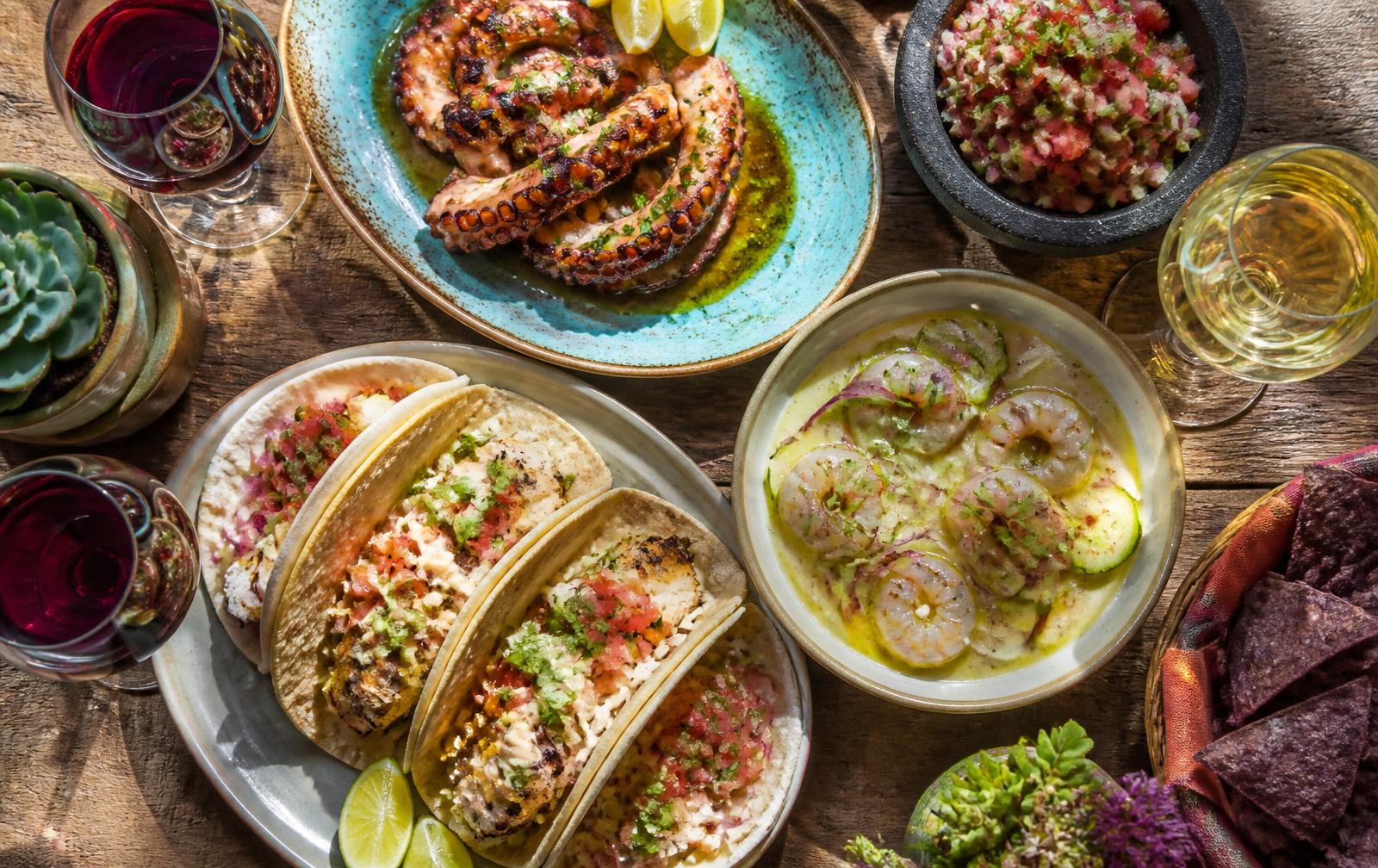
Baja Med is the valley's own cuisine: Mexican technique, Mediterranean fat, Pacific seafood. It is acidic, herbal, chile-driven and heavily grilled, which is a very specific set of demands on a wine.
Ensenada fish tacos and fried seafood
Batter, lime, crema and cabbage. You need acid to cut the fry and enough salinity to meet the lime. Pour the dry rosé at 8°C first, an unoaked or lightly oaked Chardonnay second, and a Sauvignon Blanc or Chenin third if the salsa is aggressive. Avoid anything with visible oak — vanilla and hot batter fight.
Aguachile and ceviche
Raw shrimp, serrano, lime, cucumber. This is the hardest pairing on the table because the acidity of the dish outruns most wines. Match it: a high-acid white with real mineral bite, the dry rosé, or a sparkling wine. Never a tannic red — chile plus tannin reads as metallic heat.
Grilled octopus and wood-fired quail
Char, olive oil, smoke. Now a red works, as long as it stays cool. Serve Sirius at 15°C — Nebbiolo's acidity slices the oil, and its dried-herb aromatics land right on top of the grill smoke. A lighter Astros-tier red served at 14°C is the easier, cheaper answer. A structured white with oak is the third route.
Birria, barbacoa and slow-braised meats
Deep, fatty, faintly chile-spiced. Polaris is the pairing: enough tannin to handle the fat, enough dark fruit to sit beside the chile without amplifying it. An Astrónomos Cabernet or a Malbec-heavy blend is the mid-price version. Chilled Grenache-style reds work if the birria consommé is on the lighter side.
Mole
Chocolate, chile, nuts, smoke, sweetness. Tannin is your enemy here and fruit is your friend. Go for the ripest, softest red in the range, well below room temperature, or step sideways to a rosé with weight. If the mole is a mole negro, a touch of residual sugar in the wine is a feature, not a compromise.
Aged Mexican cheeses and charcuterie
Queso Cotija, aged Ramonetti, chorizo. Salt loves tannin. This is where Polaris and Sirius both shine, and where the saline finish of Valle de Guadalupe wine stops feeling like a quirk and starts feeling deliberate.
Plant-Forward and Non-Alcoholic at the Same Table
Baja Med is unusually easy to eat well from if you are vegan or vegetarian — grilled cactus, charred peppers, roasted squash with pepita salsa, and bean-and-corn dishes with real depth. Those have weight and smoke, so treat them like the octopus: a cool red or a structured rosé, not the palest white in the fridge. Check fining information if you avoid animal products; our vegan wine collection lists verified bottles.
For guests not drinking alcohol, the valley's own flavours do the work: a hibiscus (jamaica) agua fresca over ice has enough tannic bite for the grilled dishes, tamarind with soda handles birria, and a cucumber-lime-serrano cooler is the aguachile answer. Serve them in wine glasses. For diabetic guests, the dry Estrellas reds and the mineral whites sit at the low end for residual sugar — see our low-sugar collection.
Visiting, and When
Harvest in Baja runs July through September, earlier than almost anywhere else in the northern hemisphere. Late August is the loudest, most alive moment in the valley, with the Fiestas de la Vendimia programme running across dozens of producers. It is also when rooms and tastings vanish first, so book weeks ahead.
Practicalities: it is roughly two hours from the San Diego border and half an hour from Ensenada, the roads between wineries are largely dirt, and there is very little public transport. Arrange a driver, or stay on site and taste at walking distance. Days are hot and nights genuinely cool — bring a layer for the stargazing, which is the point of the place.
Build a Baja menu with iQ
Tell iQ what you are cooking — tacos, birria, aguachile, a whole grilled fish — and it will return the wine list, the serving temperatures and a recipe for each course.
How We Found Them
This one came to us via @therealniamoore_ on Instagram, who put El Cielo on our radar long before it made our travel list. Her YouTube channel is worth your time too — genuinely funny, and a better travel guide than most of the polished ones. Thank you for the tip.