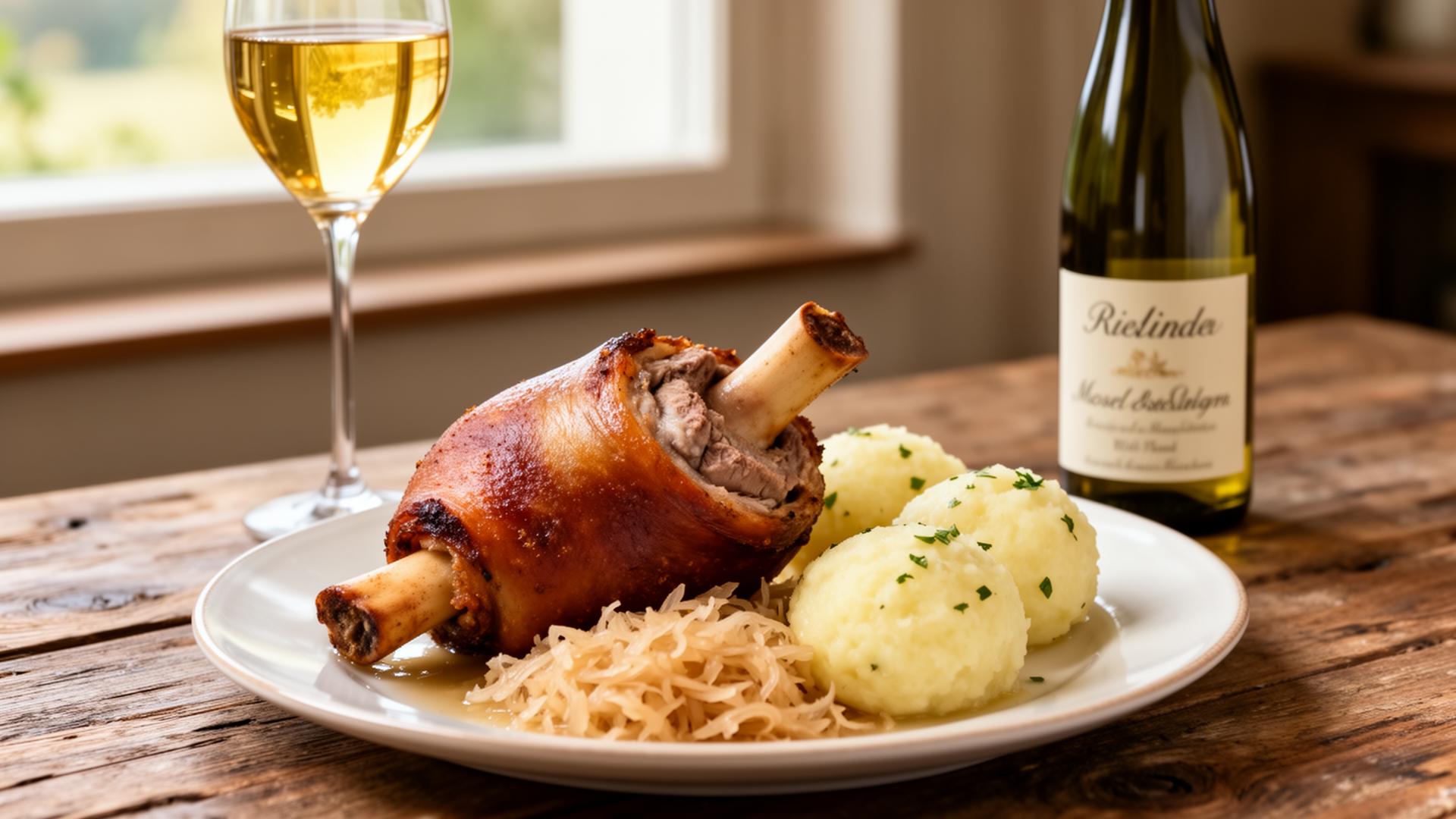
The Story Behind the Plate
German watch-party food is built around grilling, frying and slow braising. Bratwurst with mustard and sauerkraut, schnitzel with lemon and potatoes, currywurst from a Berlin street stand, sauerbraten with red cabbage and dumplings, and the bread basket that lands on every German table by reflex. The drinks default is beer, and rightly so given Germany's brewing heritage, but the country also produces some of the world's most undervalued wines. German Riesling is widely accepted as the world's most versatile food wine, and German Pinot Noir (Spatburgunder) has quietly become a serious contender to Burgundy. A German match deserves a Riesling on the table, even if a beer is in the other hand.
Why These Pairings Work
The myth of sweet German Riesling has held the category back for decades. The truth is that the Pradikat scale (Kabinett, Spatlese, Auslese) measures the ripeness of the grapes at harvest, not the sweetness of the finished wine, and many of these wines are made in off-dry or fully dry styles. For pure pairing, an off-dry Kabinett Riesling from the Mosel is the most versatile choice on a German table: it handles bratwurst and sauerkraut, schnitzel and lemon, pork knuckle and dumplings, with the same elegant lift. For richer braises like sauerbraten, step up to a Spatlese or pour a Spatburgunder from Baden. Avoid heavy oaked reds with German food. The cuisine rewards freshness, not weight.
The Match-Day Ritual
The German watch party starts with a bowl of pretzels and obatzda (a cheese and butter spread) alongside a glass of Sekt or Kolsch. The main meal lands at halftime, with bratwurst, currywurst or schnitzel as the centerpiece, served with potato salad, sauerkraut and a generous mustard board. Riesling pours throughout for the wine drinkers, while the beer drinkers stick to a crisp lager or a Bavarian Hefeweizen. Dessert is often skipped in favor of a final round of digestifs (a small glass of Kirschwasser, Williams pear brandy or a quality Riesling Eiswein, served in a tiny glass). The atmosphere is calm, focused and surprisingly disciplined, which mirrors how Germany tends to play the tournament.
Region Spotlight
The Mosel Valley produces what most experts agree is the most elegant Riesling on earth. The steep slate slopes along the river capture and reflect sunlight onto vines that struggle to ripen in this northerly climate, producing wines of stunning acidity, low alcohol (often 8 to 10 percent) and intense mineral character. Iconic producers include Dr. Loosen, Selbach-Oster, Egon Muller and J.J. Prum. The Rheingau makes fuller, riper Rieslings; the Pfalz delivers fruit-driven dry styles and the country's best Spatburgunder alongside Baden. The Nahe is the wine world's best-kept secret, producing Rieslings of Mosel-like precision with slightly richer fruit.
Choose Kabinett over Spatlese for watch-party hosting. Kabinett is the lightest of the Pradikat levels, with lower alcohol (often 8 to 9 percent) and bright off-dry fruit, which means guests can drink it all afternoon without losing focus on the match. A bottle of Kabinett goes further than a heavier wine and pairs with almost anything on the table.