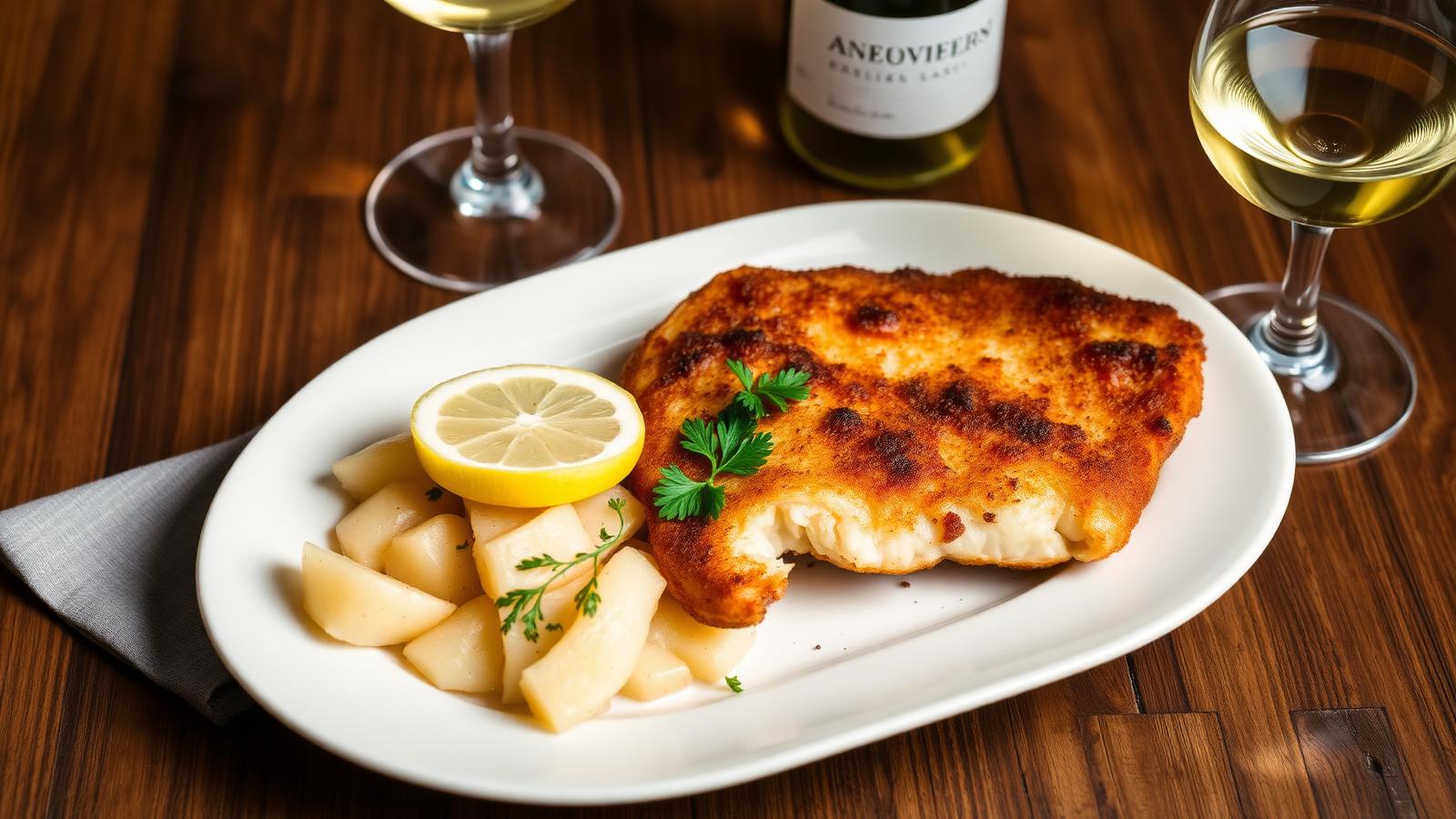
The Story Behind the Plate
Austrian cooking is the elegant survivor of the Habsburg Empire, drawing influences from Bohemia, Hungary, Italy and the Balkans into a single national tradition. Wiener Schnitzel of milk-fed veal, tafelspitz of simmered beef with horseradish, gulasch from Hungary, and the great pastry tradition of strudel, Sachertorte and Kaiserschmarrn all live on the Austrian table. Austrian wine has quietly become one of Europe's most respected categories, with Gruner Veltliner from the Wachau and Kamptal recognized as one of the world's great food wines, and Blaufrankisch from Burgenland producing some of the most age-worthy cool-climate reds in Europe.
Why These Pairings Work
Austrian food rewards Austrian wine with remarkable consistency. Gruner Veltliner is the universal Austrian table wine, with the pepper, citrus and crushed-stone profile to handle schnitzel, fried fish, asparagus, soft cheese and almost any vegetable preparation. For tafelspitz, switch to a young Blaufrankisch or a Pinot Noir from Burgenland, with enough fruit to meet the boiled beef and enough acidity to handle the horseradish. For dishes with Hungarian influence like gulasch or paprikash, a Zweigelt from the Neusiedlersee region is the most natural match. For dessert pastries, the great Austrian sweet wine tradition takes over, with Trockenbeerenauslese from Burgenland or a small glass of Eiswein providing one of the world's most luxurious finishing pours.
The Match-Day Ritual
An Austrian watch party tends to start at a Heuriger if one happens to be open, or at home with a board of speck, cured sausage, gherkins and bread, paired with a glass of young Federspiel Gruner Veltliner. The main course lands at halftime, almost always Wiener Schnitzel with potato salad and lingonberry jam, or tafelspitz with creamed spinach and apple horseradish for cooler weather. Smaragd Gruner Veltliner or a Wachau Riesling pours for the main course. Dessert is taken seriously: a slice of Sachertorte with whipped cream and a small Mokka coffee, or a piece of apple strudel with vanilla sauce, finished with a small glass of Marillenschnaps from the Wachau apricot tradition.
Region Spotlight
The Wachau Valley along the Danube, roughly 90 minutes west of Vienna, is Austria's most prestigious wine region. Steep terraced vineyards on primary rock soils produce Gruner Veltliner and Riesling of extraordinary purity, with producers like F.X. Pichler, Emmerich Knoll, Franz Hirtzberger and Rudi Pichler making wines that age for decades. The Kamptal and Kremstal regions, just east of the Wachau, offer similar grape varieties at more accessible prices, with Brundlmayer and Schloss Gobelsburg leading the way. Burgenland on the Hungarian border is Austria's red wine heartland, where Blaufrankisch, Zweigelt and St. Laurent thrive alongside the world-class sweet wines of the Neusiedlersee region.
Serve your Wachau Smaragd Gruner Veltliner at 11 degrees Celsius rather than ice cold. The richer Smaragd level (the highest of the Wachau ripeness classifications) has the body and aromatic complexity of a great Burgundy white, and over-chilling mutes the white pepper and grapefruit pith notes that make it the perfect schnitzel wine.