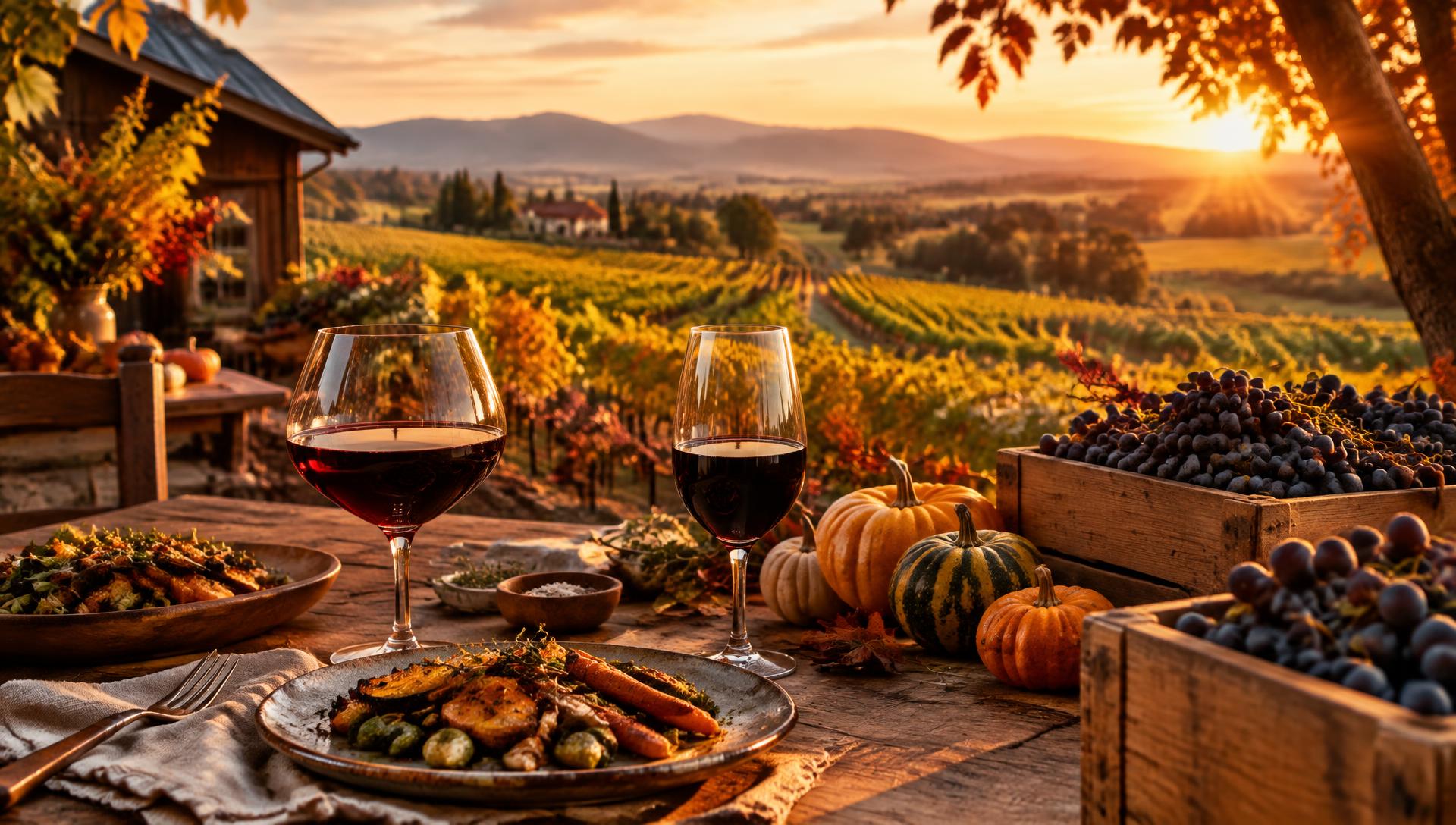
America's Autumn Cellar 2026
Crush season from Napa to the Finger Lakes, and the bottles that carry the American fall table.
September and October are the most alive months in American wine. Crush pads run around the clock from Calistoga to Dundee, the tasting rooms smell like fermenting fruit, and the country's best bottles finally line up with the way people are actually eating: roasted, braised, spiced and shared. This is the fall map of American wine, region by region, with the food each one was born for.
Willamette Valley: The Autumn Bottle
If the American fall table gets one wine, make it Oregon Pinot Noir. The Willamette Valley sits at the same latitude as Burgundy and behaves like it: red cherry and cranberry fruit, real acidity, and a savoury forest-floor edge that arrives with a few years of age. That combination is exactly what mushroom dishes, roast chicken, duck and the whole Thanksgiving spread need. Look to the Dundee Hills and Eola-Amity Hills for structure, Chehalem Mountains for perfume. Names that deliver at every price step: Cristom, Bethel Heights, Ponzi, Domaine Drouhin and Elk Cove.
Willamette also makes the country's most underrated whites. Chardonnay here has tightened up dramatically over the last decade, and the Pinot Gris is a genuinely useful autumn white — pear and spice, enough weight for squash soup. Serve the Pinots at 14°C.
Napa and Sonoma: Braise Weather Cabernet
Napa Cabernet spends the summer looking like an extravagance and the fall looking like a necessity. Cassis, cedar, graphite and polished tannin were designed for short rib, lamb shoulder, prime rib and anything cooked for three hours in a covered pot. The classic subregions each tilt the match: Rutherford for dusty structure, Oakville for depth, Howell Mountain for tannic power that wants fat on the plate.
If Napa pricing is doing what Napa pricing does, Sonoma is the answer. Alexander Valley Cabernet delivers most of the profile with softer edges and friendlier numbers, Dry Creek Zinfandel is superb with barbecue and sweet-glazed dishes, and Russian River Pinot Noir and Chardonnay give you the elegant end of the spectrum. The Sonoma Coast Chardonnays — Flowers, Hirsch territory — are among the best whites made anywhere for roast birds.
Finger Lakes: Riesling Is the Squash Answer
New York's Finger Lakes makes Riesling that ranks with Germany's, and fall is when it becomes indispensable. Dry versions from Hermann J. Wiemer, Ravines and Dr. Konstantin Frank cut through pork, apples and roast root vegetables. Off-dry versions — the ones with a few grams of sugar — are the single best pairing for butternut squash, spiced pumpkin dishes and anything with a maple glaze, because they meet the sweetness rather than clash with it.
The region's Cabernet Franc deserves attention too: peppery, herbal, medium-bodied, and one of the few American reds that pairs comfortably with green vegetables and tomato-based autumn dishes.
Paso Robles, Santa Barbara and Washington
The American Rhône movement peaks in autumn. Paso Robles GSM blends — Grenache, Syrah, Mourvèdre from Tablas Creek, Saxum and Denner — bring garrigue, brambly fruit and warmth that suits lamb, herb-roasted vegetables and anything cooked over wood. Santa Barbara's Sta. Rita Hills produces a cooler, more peppery Syrah, closer to the northern Rhône, that is outstanding with duck and mushroom.
Washington State is the value story of this category. Walla Walla and Red Mountain Syrah has the smoky, meaty character that matches brisket and smoked shoulder straight off the smoker, and Washington Cabernet frequently outperforms California bottles at twice the price.
The Regions Americans Overlook
Virginia's Monticello AVA is making Cabernet Franc and Petit Manseng of real seriousness — Barboursville and Early Mountain are the entry points, and the Franc is a wonderful Thanksgiving red. Texas High Plains does Tempranillo and Mourvèdre built for brisket. Michigan's Leelanau Peninsula makes precise Riesling and traditional-method sparkling. Arizona's Verde Valley turns out Rhône blends with a desert signature of its own.
All four are pouring in tasting rooms within a couple of hours of large parts of the country. If your idea of American wine stops at California, fall is the season to fix that.
The Thanksgiving Plan
American Thanksgiving is the hardest pairing of the year: fifteen dishes, half of them sweet, on one plate. The strategy is not to find a perfect match but to pour wines that never fight. Willamette Pinot Noir is the safest red. Finger Lakes dry Riesling or Sonoma Chardonnay covers the whites. A dry rosé handles the guests who cannot decide, and a bottle of American sparkling — Schramsberg, Gruet, Roederer Estate — opens the afternoon and quietly outperforms everything else with the turkey skin.
Bottle math: one bottle per two adults across a four-hour meal, plus two spares. Open the reds an hour ahead and keep them at 16°C, not room temperature.
Build Your Fall List with iQ
Tell the iQ Sommelier the dish and your budget and it will return American options with a lower-cost twin for each, tuned to what is actually available near you. Scan a label in the store to check it against tonight's menu before you buy.