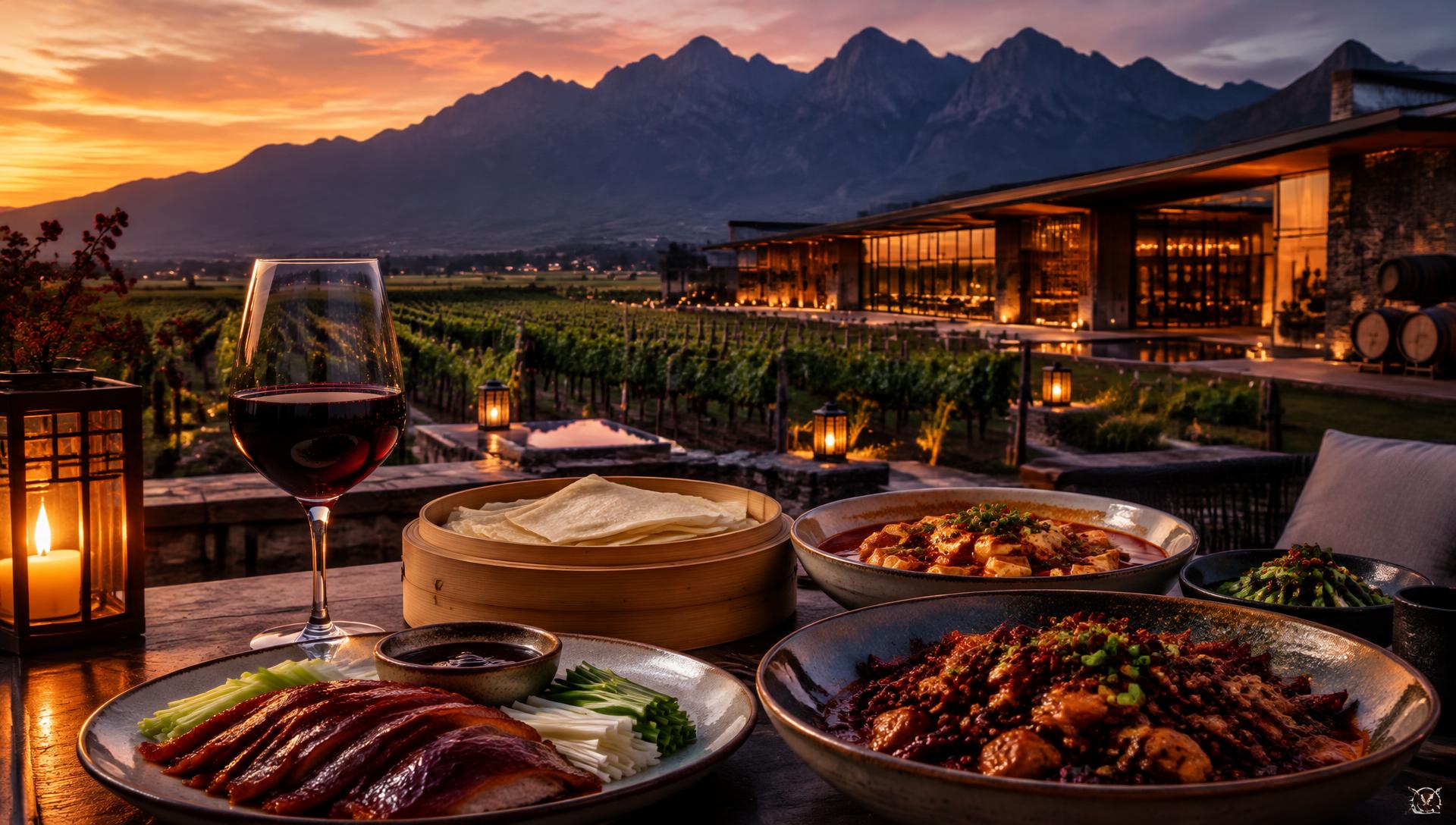
China's Wine Country 2026
Ningxia, Shandong and Shangri-La — the regions, the bottles, and how to pair wine with the Chinese table.
Twenty years ago, a serious Chinese wine was a curiosity. Today Ningxia estates win blind tastings against Bordeaux, and a generation of winemakers trained in Burgundy, Adelaide and Davis is working vineyards from the Gobi's edge to the Himalayan foothills. At the same time, the harder and more interesting question is the one nobody outside China spends enough time on: what wine actually belongs with Chinese food?
This guide covers both — the regions worth knowing, and the pairing logic for Sichuan, Cantonese, Hunan, Shandong and the northern table.
Ningxia: The Helan Mountain Benchmark
The eastern foothills of the Helan Mountains, on the edge of the Gobi in Ningxia, are China's most important wine address. The conditions are extreme in a useful way: high altitude, intense sunlight, gravelly alluvial soils, and a day-to-night temperature swing that preserves acidity while the fruit ripens fully. Vines are buried each winter to survive the cold, a labour cost no European region carries.
The results are structured, dark-fruited Cabernet Sauvignon and Bordeaux-style blends with firm tannin and a mineral, dusty finish. Silver Heights, run by Emma Gao after a Bordeaux apprenticeship, is the region's reference. Kanaan makes a memorable Cabernet and a Riesling that few expect. Helan Qingxue put the region on the map with the 2009 Jia Bei Lan. Jade Vineyard and Chateau Changyu Moser XV represent the modern estate style.
Marselan — a Cabernet-Grenache cross — has become something like China's signature grape here: plush, spicy, less austere than Cabernet, and a far better match for Chinese food.
Shandong, Xinjiang, Hebei and Yunnan
Shandong, on the Yellow Sea coast around Yantai and Penglai, is China's oldest modern wine region and still its largest by volume. The maritime climate brings humidity challenges but produces softer, earlier-drinking reds and some good Chardonnay.
Xinjiang, far northwest, has abundant sunshine and dry air, and makes powerful, high-alcohol reds; the region is increasingly a source of quality fruit for larger producers.
Hebei, near Beijing, hosts Huailai and Changli, where Chardonnay and Cabernet Gernischt — long thought to be Carménère — have a long history.
Yunnan is the most romantic story in Chinese wine. In the Shangri-La region, vineyards sit above 2,000 metres in Himalayan valleys, where LVMH's Ao Yun makes one of Asia's most expensive wines from plots tended by Tibetan villagers. The wines are dense, floral and genuinely distinctive.
Pairing Sichuan and Hunan: Heat Changes the Rules
Chilli heat and Sichuan peppercorn do specific things to wine. Capsaicin amplifies the perception of alcohol and tannin, so a 15 percent Cabernet beside mapo tofu tastes hot, bitter and abrasive. The numbing quality of huājiāo compounds it by dulling the palate to subtlety.
The rules that work: lower alcohol, higher acidity, some sweetness, minimal tannin. Off-dry Riesling from the Mosel or the Finger Lakes is the single best all-purpose bottle for Sichuan food. Gewürztraminer handles the aromatics of Hunan chilli and garlic. Dry sparkling wine — Champagne, Cava, or Chinese traditional-method sparkling — resets the palate between bites. If the table wants red, chill a Gamay or a light Pinot Noir to 13°C and skip anything oaked.
Cantonese, Dim Sum and the Delicate Table
Cantonese cooking is the opposite problem: steamed fish, poached chicken, clear soups and delicate dim sum are easily overpowered. Here you want precision. Dry Riesling, Chablis, Muscadet, Albariño and Grüner Veltliner all work with steamed seafood and ginger-scallion preparations. For dim sum's range — har gow, siu mai, char siu bao, turnip cake — sparkling wine is the only bottle that covers everything at once.
Char siu and roast meats push toward red: a Ningxia Marselan, a Pinot Noir or a Beaujolais Cru handles the sweet-savoury glaze without overwhelming it.
Peking Duck, Hot Pot and the Northern Table
Peking duck is one of the world's great wine pairings and does not get enough credit. The crisp fatty skin, sweet hoisin, raw scallion and thin pancake need acidity to cut and fruit to meet the sauce. Pinot Noir is the classic answer. A mature Ningxia Bordeaux blend or a Cabernet Franc makes for a superb regional pairing, and Champagne is never wrong with duck skin.
Hot pot is harder because the broth dominates. For a clear mushroom or chicken broth, a Chardonnay or a dry Riesling works. For a spicy Chongqing broth, go back to the Sichuan rules — off-dry white, sparkling, or a well-chilled light red — and accept that beer and wine are competing on equal terms.
Lamb skewers, cumin-heavy Xinjiang cooking and northern braises are where Chinese red wine shines brightest: a Xinjiang or Ningxia Syrah beside cumin lamb is a pairing that should be far more famous than it is.
How to Buy Chinese Wine
Quality varies widely, so the producer and region matter more than the country. Start with a named Ningxia estate rather than a generic label, look for Helan Mountain East on the bottle, and expect to pay something in the range of a good New World Cabernet for the top wines. Outside China, specialist importers in the UK, US and Hong Kong carry Silver Heights, Kanaan and Ao Yun; availability is improving each vintage.
Pair Your Table with iQ
The iQ Sommelier handles the heat-and-tannin math for you. Enter a dish — mapo tofu, char siu, Peking duck, cumin lamb — and it returns pairings scaled to spice level, texture and your dietary needs, including non-alcoholic options where the table calls for them.